Jesus left heaven and moved into the neighborhood. He embodied relocation of the highest form, becoming human and leaving His Father to live on earth. Those of us today who seek to see transformed neighborhoods can also relocate, and like Jesus, must truly relocate in some way in order to be close to the people and places that we desire to see changed. I'm excited to share a bit more about this revolutionary principle of Christian Community Development (CCD) today.
Traditionally in the CCD philosophy, Relocation has meant that people are moving into the neighborhood where they are planting a church and seeking the good of the whole community through many aspects of neighborhood flourishing. Sometimes, the family is a true "relocate-r" in that they have not lived in that area of the city before. Sometimes, the family or individual is a "return-er", meaning they grew up in the neighborhood, and have chosen to come back to encourage and equip their community, perhaps after obtaining a college education or other skills.
With Iowa Heartland Habitat, I am blessed to relocate to the neighborhoods where we are building, not through purchasing my own home there, though we do as an organization own many properties that are in the process of being restored. Rather, I practice Relocation through my presence. CCDA refers to this as the "ministry of presence". Presence is not to be discounted as a genuine form of relocation. In fact, sometimes people will physically relocate to a neighborhood by moving there, but if they are not spending a significant amount of time in and around the neighbors, buildings, and streets, they will not have as deep or genuine of an impact in that place as someone who is intentionally proximate but may not own property there. This is why the ministry of physical presence is so vital. In addition, the principle of Relocation asks us to consider relocating our hearts, not just our bodies, in order to see the needs around us, listen to the people in proximity to us, and prayerfully consider how we could respond to those needs.
I was recently listening to an episode of the FCS Podcast, Place Matters, called "Seeing Place as Parish". In it, David Park speaks with two church leaders, one of whom leads a church that encourages their congregation to "Love your neighbor where you are". This is a good start to Relocation, because it gets at the point of place-based neighborhood ministry. Loving your physical neighbor is key to Relocation because it highlights how significant a neighbor-to-neighbor relationship is. However, I want to note that the idea of "Love your neighbor where you are" can be insufficient if we're not careful. If my "neighbor" only looks like me, talks like me, and has similar resources as I do, I may not be getting a full picture of God's command to love my neighbor. In certain communities, it can be very easy to ignore or avoid the greatest needs and darkest spaces. In an isolated and more individualistic society, this emphasis on relocating our presence, our influence, and perhaps our living space to neighborhoods where we may not normally find ourselves becomes very important.
This reminds me of a quote that I heard at a virtual CCDA Bible Study in October 2024. Someone wise said, "Proximity to pain changes your very soul." Relocating your life and presence to places where people are hurting in ways that you haven't experienced before will change you. My life certainly has changed through the past few years working with Iowa Heartland Habitat for Humanity--for the good. My capacity for compassion has grown, and I have been able to empathize with so many people from such a wide variety of walks of life. I am not a "relocate-r" in the traditional sense, nor a "return-er" who originally grew up in Waterloo, but I do give my time and presence to neighborhoods that are full of beauty and strengths that are being built upon as I write this.
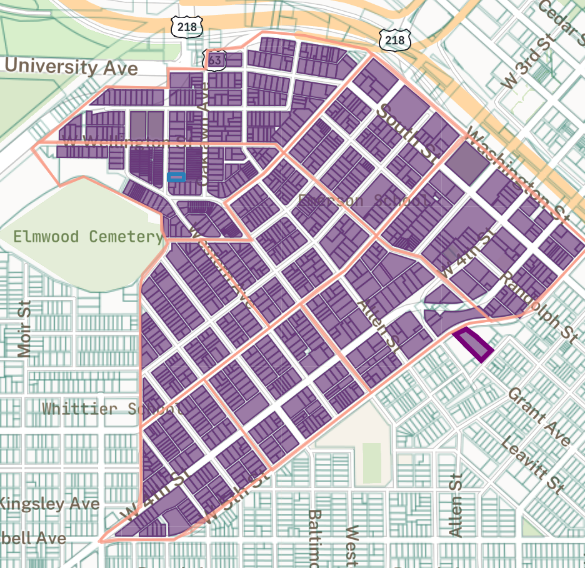
If you are along this journey of work in Walnut and Church Row, I want to say thank you. I am grateful for you and your influence on my life through this transformational work. I've chosen a picture of the map of Church Row neighborhood to be the featured image at the top of this page because it is one of those places that I am consistently present and actively working to seek its flourishing.